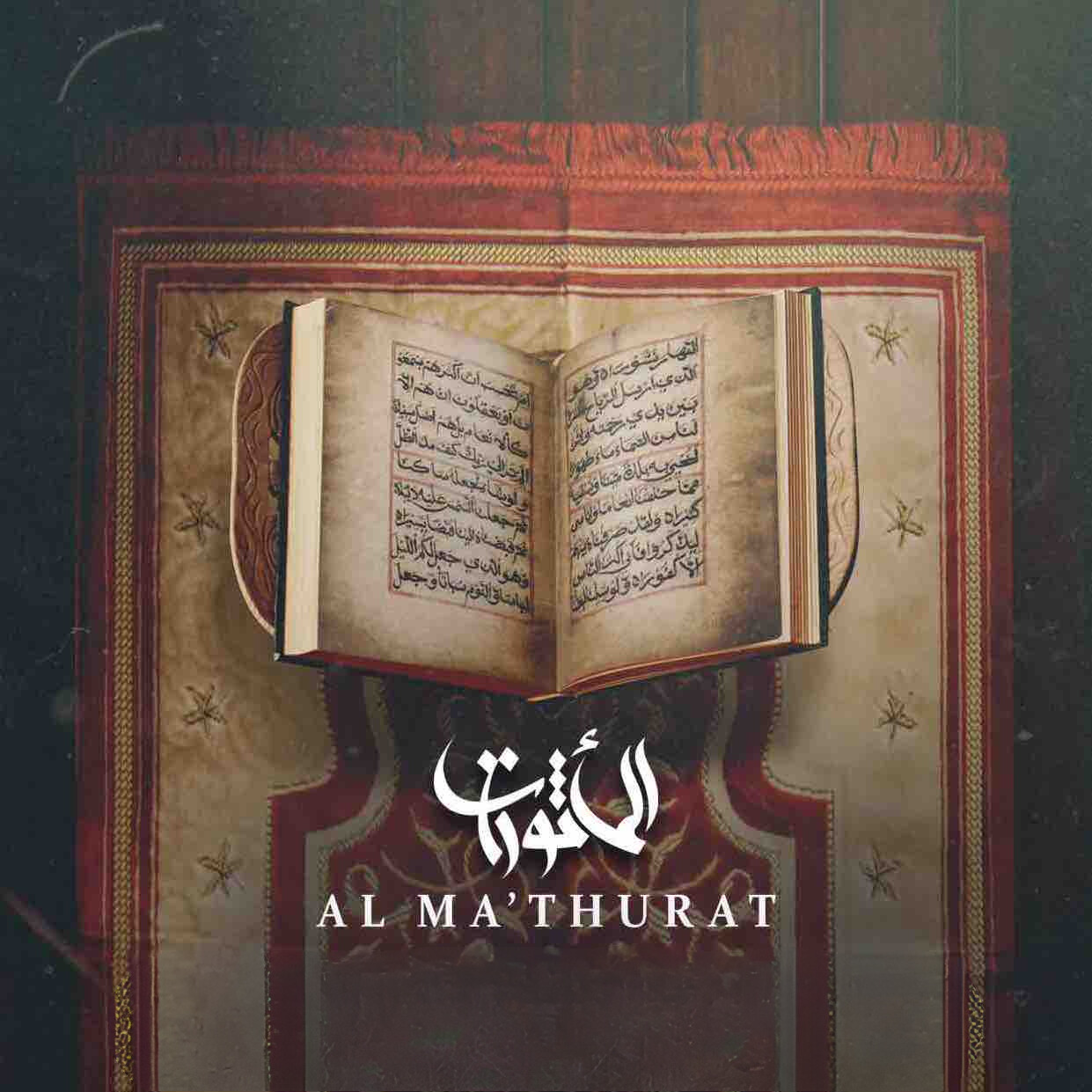
Al-Ma'thurat
Preface
by Imam Hasan Al-Banna
Ramadan 1355 AH · 1936 CE
Praise be to Allāh, Lord of the worlds. May the peace and blessings of Allāh be upon our Prophet Muhammad
, the best to perform the dhikr (remembrance) of Allāh and to give shukr (gratitude), Imam of all the Messengers, the last of all the Prophets and the most renowned leader. May the Peace and Blessings of Allāh also be upon his family, his companions and those who follow their rightful path till the Day of Judgement.I. DHIKR AT ALL TIMES 🔗
Each human being pursues an ultimate and fundamental goal in life. This goal constitutes one's ideals, the focal point of one's thoughts, aspirations and activities. The loftier and nobler this goal is, the more sublime are the thoughts and deeds emanating from it.
The basic message of Islam is to elevate the soul, to purify and uplift it to the highest possible plane. This cannot be accomplished unless Allāh is our ultimate goal and the focus of our life. As the Qur'anic verse states, "So flee to Allāh, Verily I (Muhammad) am a plain warner to you from Him." Surah al-Dhariyat, 51:50
There is no wonder then that the Messenger of Allāh used to engage in dhikr at all times. Following the Prophet's example, dhikr should be part of daily life so that one may become closer to Allāh. “Indeed in the Messenger of Allāh you have a good example to follow for him/her who hopes in (the meeting with) Allāh and the Last Day and remembers Allāh much.” Surah al-Ahzab, 33:21
II: VIRTUES OF DHIKR 🔗
Numerous verses of the Qur'an deal with the virtues of dhikr and those performing it. Allāh says, “For Muslims, men and women, for believing men and women, for devout men and women, for true men and women, for men and woman who are patient and constant, for men and woman who humble themselves, for men and women who give in charity, for men and women who guard their chastity, and for men and women who engage in the dhikr of Allāh, for them Allāh has prepared forgiveness and great reward.” Surah al-Ahzab, 33:35
In another place in the Qu'ran, Allāh orders the believers: “O you who believe! Remember Allāh with much remembrance. And glorify His Praises (in the) morning and evening.” Surah al-Ahzab, 33:42
There are also numerous ahadith indicating to the virtues of dhikr. In a Hadith Qudsi, the Messenger of Allāh reported that Allāh said: “I (will respond according to) what my servant thinks of Me, and I am with him/her when he/she remembers Me. So if he/she remembers Me in secret. I will remember him/her in secret and if he/she remembers Me in a group, I will remember him/her in a better group [among the angels].” Related by Bukhari & Muslim
In another hadith it is reported on the authority of Abdullah ibn Busr that a man went to the Prophet and said: “O Messenger of Allāh! The laws and conditions of Islam have become too many for me. Tell me something that I can always keep and uphold. The Prophet said: “Keep your tongue always moist with the dhikr (remembrance) of Allāh.” Related by Tirmidhi, Ahmad, Ibn Majah, and Ibn Hibban.
III: ETIQUETTE OF DHIKR 🔗
Dhikr is not only limited to words; repentance is dhikr, reflection is dhikr, seeking knowledge is dhikr, seeking lawful provisions (provided that the intention is correct) is dhikr and generally, every lawful act during which the presence of Allāh is felt is dhikr.
For dhikr to bear fruit, the following etiquette should be observed:
- Humility, sobriety, and pondering over the meanings of the dhikr and du'a.
- Lowering one's voice as much as possible so as not to disturb others but at the same time one must be completely awake. As Allāh says, “And remember your Lord by your tongue and within yourself, humbly and with fear without loudness in words in the mornings, and in the afternoon, and be not of those who are neglectful (of His remembrance).” Surah al-A'raf, 7:205
- Abiding by the sequence of the group if the dhikr is performed collectively. One should not be too fast nor too slow in observing the sequence but rather keep up with the pace of the group.
- Cleanliness and respectability of clothes in the place of dhikr.
- Leaving (the circle of dhikr) with khushu (tranquility) and adab (well-mannered) and thus refraining from excessive talk and jesting that will void one of the benefits of dhikr.
By observing these guidelines, one will find happiness in his/her heart, light in his/her soul and blessings from Allāh .
IV: DHIKR IN A GROUP 🔗
Engaging in dhikr collectively in a group is permissible. Indeed, it is encouraged in some ahadith. In a hadith, the Prophet said: “If a group of people sit together remembering Allāh, the angels will surround them, the mercy will shroud them, the peace will descend onto them and Allāh will remember them among those with Him.” Related by Muslim.
In many ahadith, it can be noticed that the Messenger of Allāh would pass by a group of Companions who were collectively engaged in the dhikr of Allāh and give them good news and would not condemn them (ie. their practice).
[For example, in a narration of Muslim, Tirmidhi and Nisa'i, the companion Mu'awiyah relates that: “The Messenger of Allāh went out to a circle of his companions and asked: “What made you sit here?” They said: “We are sitting here in order to remember and mention Allāh and to glorify Him because He guided us to the path of Islam and conferred His favours upon us.” Thereupon he adjured them by Allāh and asked if that was the only purpose of their sitting there. They said: “By Allāh, we are sitting here for this purpose only.” At this the Messenger of Allāh said: “I am not asking you to take an oath because of any misapprehension against you, but only because Jibra'il (Angel Gabriel) came to me and informed me that Allāh, the Exalted and Glorious, was telling the angels that He is proud of you.”]
Engaging collectively in a group in acts of obedience is deemed mustahab (recommended and praiseworthy) as it can lead to many benefits e.g. it brings the hearts of the Muslims together, strengthens their noble ties, and helps teach others. However, if the collective dhikr disturbs those who are praying or turns into a gathering full of foolish talk and laughter or the like, then in such circumstances it is not permissible to engage in dhikr in a group.
V. CONCLUSION 🔗
We present this wazifa to the members of al-Ikhwan. However, this is not specific to them but it is for all the Muslims. It should be read individually or in a group in the morning between Fajr and Dhuhr and in the evening between Asr and Isha.
We pray to Allāh for complete guidance and may the peace and blessings of Allāh be upon our master Prophet Muhammad , upon his family and upon his companions.
Imam Hasan al Banna
Ramadan 1355 AH (1936 CE)